Five interviews showed that students use class chats to ask low-pressure questions, restate instructions in peer language, participate by reading or reacting, and support one another. The same chats can also spread incorrect information, create notification stress, and blur academic-integrity boundaries.
Reflective Cover Letter
The purpose of this paper is to explain how student-run class group chats function as academic writing spaces. I want readers to see that these chats do more than spread reminders: they help students interpret assignments, recognize shared confusion, and participate without always contacting the professor. I imagined you and my classmates as the main audience, but I also wrote for readers unfamiliar with the project. This made me define the topic clearly and avoid treating five interviews as representative of every college student.
The project developed through the proposal, annotated bibliography, CARS activity, interviews, coding exercise, and two drafts. Feedback showed that I needed to make the coding visible, use more secondary sources in the Discussion, add more support for the analysis, and explain where the research could go next. I added a coding table and chart, expanded the Discussion, separated Results from interpretation more clearly, and developed the conclusion into a future research plan. Because I took written interview notes rather than recordings, I use paraphrase instead of saying I have exact quotations.
This paper demonstrates progress in inquiry, information literacy, genre awareness, knowledge production, and revision. The question became more focused over time, the sources helped me interpret the primary data, and the genre framework helped me explain class chats as recurring social actions rather than simply as apps.
Final Paper
Research question: How do college students use student-run class group chats to clarify course expectations and support one another outside official classroom spaces?
Method: Five semi-structured interviews, written interview notes, participant labels P1–P5, and a simplified open-coding process.
Main claim: Student-run class group chats act as low-stakes academic support genres. They reduce the pressure of asking questions, allow students to translate official course language into peer language, and make room for participation through reading and reacting. Their usefulness depends on trust, reasonable boundaries, and knowing when to check official information.
Research used: The Discussion compares the interviews with nine sources on genre, messaging, audience, participation, engagement, coding, and peer support.
Download the redacted final paper and appendices
Data Display
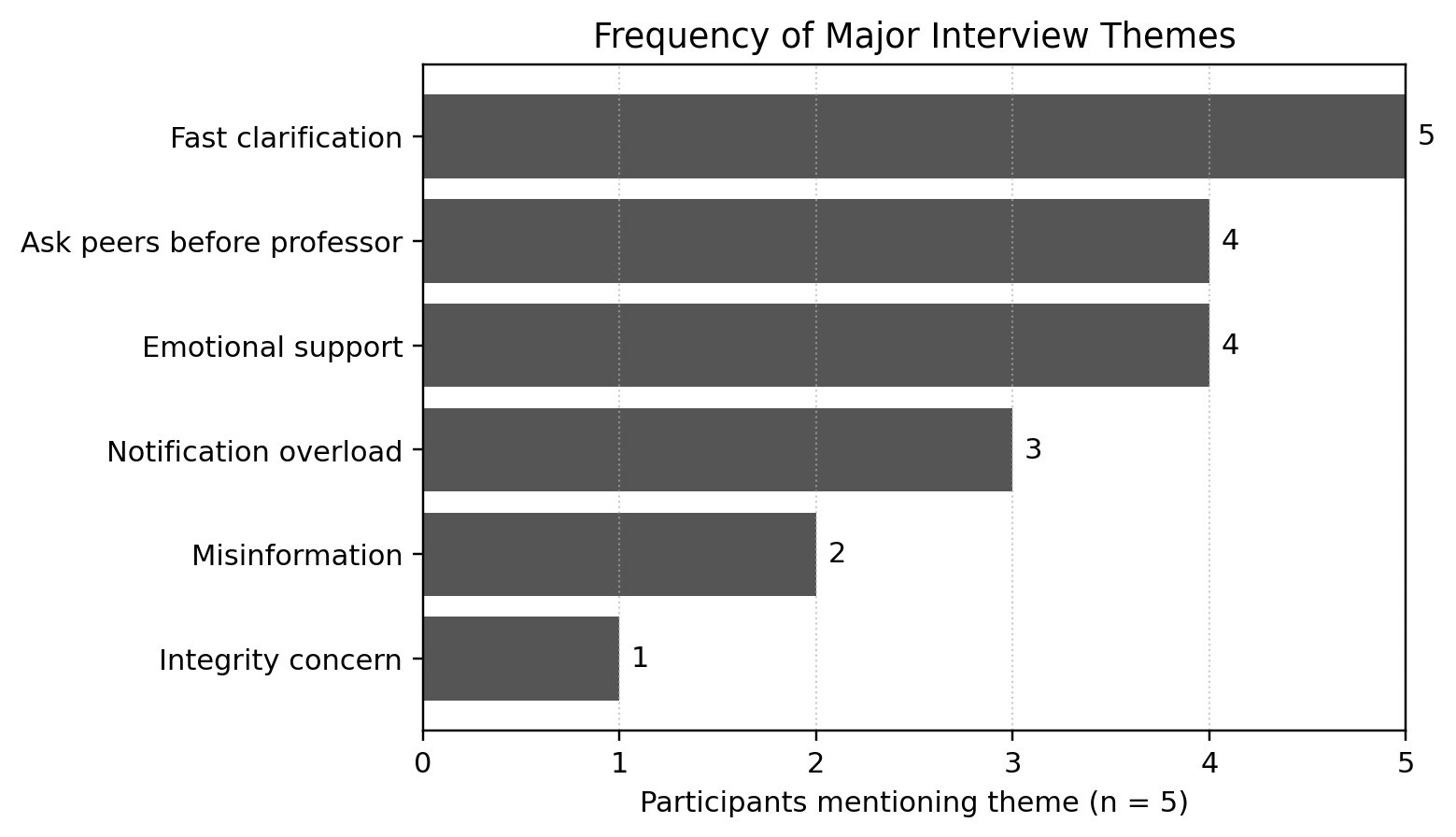
The final version includes both a codebook and a chart. The table explains how I grouped the interview codes, while the chart shows how many of the five participants mentioned each main pattern.
Table 1
Coding Framework for Interview Notes
| Broad theme | Initial codes combined | Operational meaning | Participants |
|---|---|---|---|
| Quick academic information | Clarification; deadline checking; missed-class information | Messages seeking or confirming course facts and instructions | 5 of 5 |
| Audience and rhetorical cost | Professor avoidance; informality; speed | Reasons peers felt easier to contact than instructors for simple questions | 4 of 5 |
| Quiet participation | Reading; reacting; answering selectively | Receiving or confirming information without frequent original posts | 5 of 5 |
| Emotional and social support | Reassurance; shared frustration; humor | Messages that reduced isolation or normalized difficulty | 4 of 5 |
| Risks and boundaries | Notification stress; misinformation; integrity concern | Problems caused by volume, unreliable answers, or inappropriate sharing | 1–3 of 5 |
Note. Counts show whether a participant mentioned a theme at least once; they do not measure the total number of messages or the strength of each opinion.
Revision Map
Draft 1 to Revision 1
- Defined “student-run class group chat” more clearly.
- Followed the CARS model more closely and made the main claim more specific.
- Explained how I chose participants and what the convenience sample cannot show.
- Explained the open-coding process in more detail.
- Separated the findings into four sections.
- Added a discussion of how students restate official instructions in peer language.
- Connected the findings to genre, audience, and the pressure students feel when asking for help.
- Added more about the limits of the study and possible future research.
- Rewrote the conclusion to answer the research question directly.
Revision 1 to the Final Paper
- Added the reflective cover letter.
- Added the coding table and theme-frequency chart.
- Added more secondary sources and used them throughout the Discussion.
- Explained the choice to use written notes and paraphrase rather than recordings and direct quotations.
- Reworked the findings around clearer theme labels and added more support for the analysis.
- Turned the conclusion into a specific plan for larger surveys, message analysis with consent, student-created chat norms, and research on assignment design.
- Added four appendices containing the records behind the study.
The original Draft 1 Word document, Revision 1 PDF, and redacted final Word document are all available so readers can compare the versions directly.
Appendices
The submitted Word document includes:
- Appendix A: Completed interview consent records.
- Appendix B: Semi-structured interview protocol.
- Appendix C: Participant-level coding matrix and open-code table.
- Appendix D: Dated interview-note records for P1–P5.
I kept the appendices in the downloadable file instead of reproducing them on this public page. In that public copy, the consent records use P1–P5 in place of participant names. The submitted Canvas document remains unchanged.